The Science Behind ECP
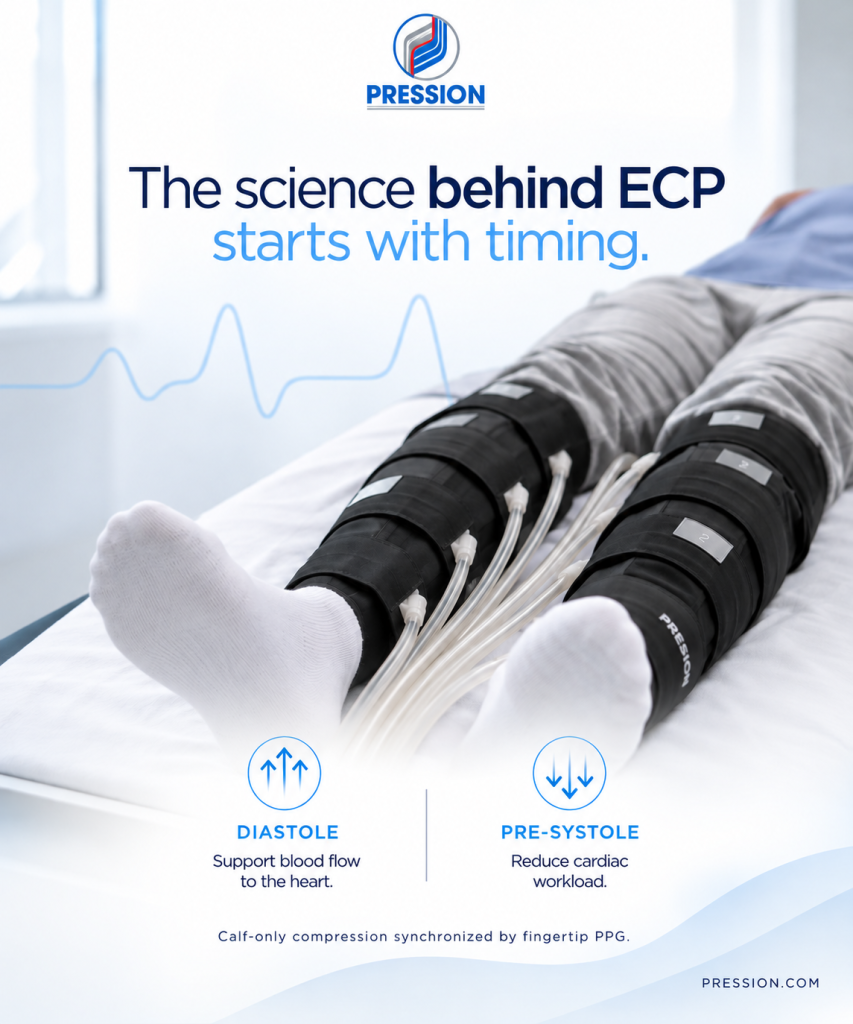
The science behind ECP starts with timing.
External Counterpulsation (ECP) uses precisely timed compression and release to influence blood flow at two distinct phases of the heartbeat—with two complementary goals: support blood flow to the heart and reduce the work the heart has to perform.1
During diastole — support coronary perfusion
As the heart relaxes between contractions, external compression helps move blood toward the heart and increase diastolic pressure. Because the coronary arteries receive much of their blood flow during diastole, this increased pressure supports blood flow to the heart muscle.
Before systole — reduce cardiac workload
Immediately before the heart contracts, the cuffs rapidly deflate. This reduces afterload—the resistance the heart must pump against—allowing the heart to eject blood with less work.1
The result — address both sides of the equation
ECP is designed to support blood supply to the heart while simultaneously reducing the workload required to pump.
Wave PRO™ delivers ECP using calf-only sleeves, with compression automatically timed by a fingertip PPG sensor to synchronize cuff inflation and deflation with each patient’s cardiac cycle.
The therapy is established.
The shift is in how it’s delivered.
1 WaveCRESST clinical study, NCT06571370. Individual results may vary.
Indications for Use: The Pression Wave PRO™ External Counter-Pulsation System is indicated for the treatment of chronic stable angina (CSA) that is refractory to optimal anti-anginal medical therapy and without options for revascularization in adult patients that weigh greater than 40kg. In addition, it is intended for use in healthy adult patients to provide improvement in vasodilation, increased VO2, and increased blood flow. It is intended for use under the supervision of a healthcare professional.
For use only on the order of a licensed physician. See pression.com for full prescribing and safety information.